


Hi there,
Growth teams have become all the rage for startups over the last years. They’re more than just a fad that will come and go; they’re a chance to provide focus to your brand and stand a chance in this oversaturated society.
Despite the popularity of growth teams, little has been shared about their value, and how to actually build a strong team.
So I took my decade of experience in growth, and time as a Head of Growth, and created a overview to help you figure out whether you need a growth team, and suggest 2 ways to structure it. There’s also a third model, see the recommendation to learn more.
But first: do you even need a growth team?
A growth team is experimentation-driven rather than trying many different things and hoping something works. We are taking a scientific approach to growth by focusing on the data rather than the assumptions.
If you are missing a structured and focused approach to growth across the various teams, a growth team could be your answer.
These are indicators that you need a growth team:
You have several team members already. Any less than four and it might be overkill to start using this structure.
You have Product-Market Fit. Note you can use a growth team to focus on Product-Market Fit, but then the sprints and structure will be overkill.
You are struggling with focus. When everyone is working on separate initiatives and goals, you might find that you are doing a lot, but not really moving the needle on any of it.
You are struggling to drive impact with what you do. Getting everyone in a room with different backgrounds and insights to prioritise and work together can allow you to achieve far more and find better areas of impact.
You are struggling to get teams to collaborate effectively around growth. Silos can exist even in smaller organisations and result in misalignment, fighting over resources and worse outcomes with problems only being approached from one perspective.
Structuring your team: the independent model
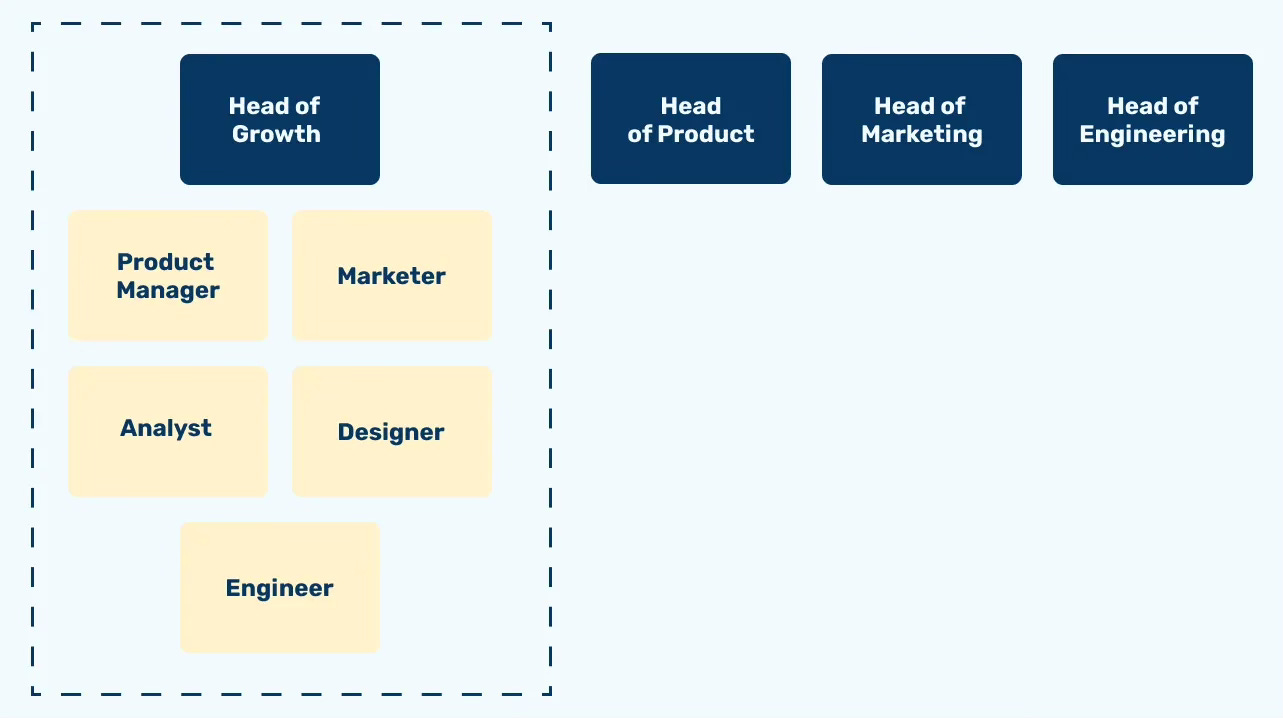
Here growth is seen as an independent department; the people within this team are only focused on growth. Uber, Airbnb and Facebook all use this structure.
The growth team still works closely with other departments, but the growth manager is at the same level as other heads. Once the organisation grows, this will split into multiple separate growth teams:
Advantages:
The team has the freedom to make decisions and risks
The team can move faster as it only focuses on growth, not daily responsibilities
The structure of the team can change according to the needs of the organisation
Growth doesn’t get mistakenly labelled a marketing or product issue
Disadvantages
This can cause friction with other parts of the organisation, as the growth team may move faster or beyond the usual rules of the organisation
It requires an experienced growth manager to lead the team
It implies that one team is responsible for growth vs the organisation
There is not always enough work for a full-time role in the growth team
Often there are still dependencies on other teams for growth to occur
Option 2: the cross-functional model
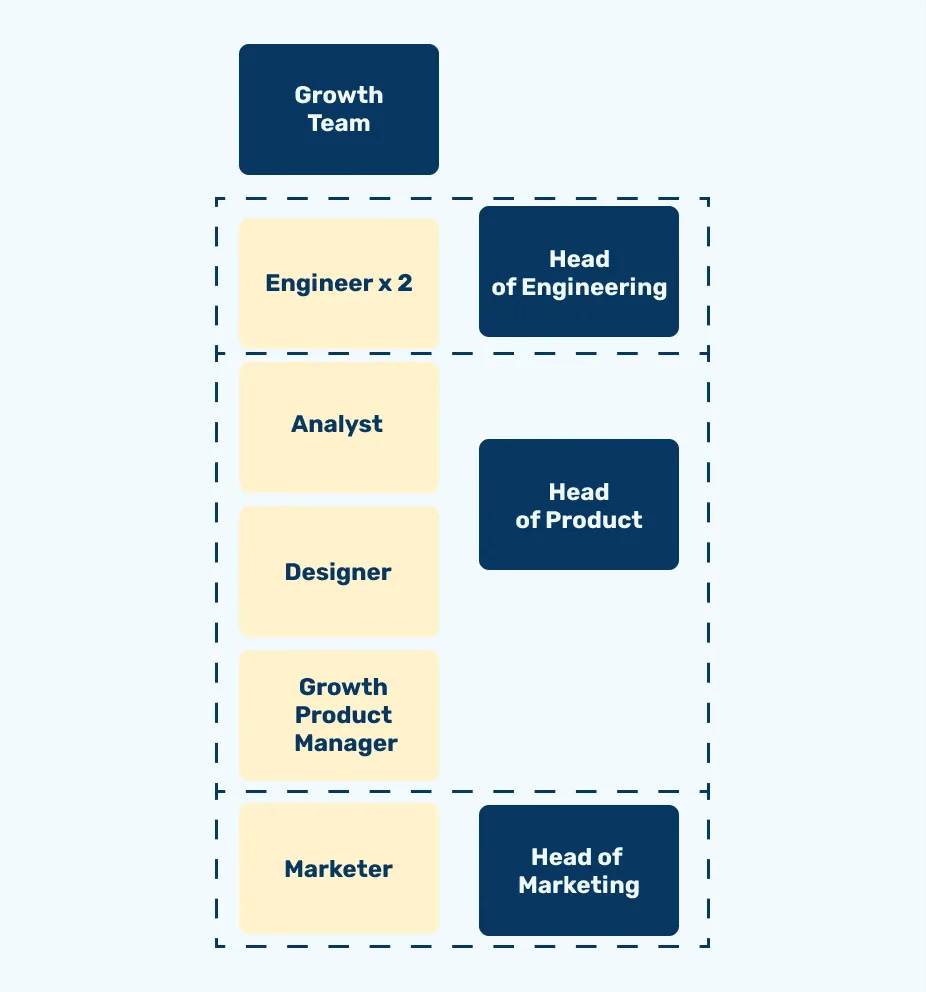
Here (almost) everyone is part of a growth team. You create multiple teams, each with its own goal, e.g. a part of the customer journey, but also have their day-to-day work. Two famous examples of companies utilising this structure are Pinterest and Hubspot.
They do not tend to report to the growth (product) manager but to their department heads. But the growth manager will still help to decide what they are working on within the growth teams. So as the organisation grows, you get multiple growth teams spanning across the departments:
Advantages
Everyone feels partially responsible for the growth
It gets a broader range of people involved resulting in more ideas
There is no need necessarily for a separate head of growth but growth managers / product manager report to product/marketing
Growth is more bottom-up instead of top-down
Disadvantages:
Adds complexity to the organisation as who you report to and who decides your work are different
Requires multiple people in the organisation to lead growth which may still lead to a lack of ownership
It doesn’t necessarily work for too small an organisation (it becomes a pretty complicated structure)
This can result in competing priorities for multiple individuals as they will still have their day-to-day work
Recommendation
In every edition of Growth Waves, I also share a related book, individual or newsletter to check out related to the week's topic.
If you want to learn more about growth teams, I’ve written a comprehensive guide that covers everything you need to know.
I cover who to include in your team, the third option for structuring the team (and its advantages and disadvantages), and a 7 step guide to defining your team’s process.
Check it out below!
Also, it’s not too late to sign up to my free online webinar with VWO on 27th March at 9:30AM EST (13:30 GMT).
We’ll look at:
Why Message-Market Fit is imperative for your business
How to know if you have a messaging problem
A step-by-step process for improving and testing for Message-Market Fit
The session will run for 40 minutes and you can sign up through the link below.
Now you know more about growth teams its time to decide if you want to build your own. If you feel it could be a relevant solution to your challenges start working through the seven steps and identifying which setup best suits your needs.
While a growth team isn’t a magic solution to all your growth challenges, it is a powerful way to better align your organisation and work more effectively to solving your growth challenges.
Good luck, and chat soon,
Daphne.