


Hi there,
Yes, 80% of trials start on Day 0. Yes, the onboarding paywall matters. And yes, you should absolutely optimise it.
But here’s something I’ve noticed working with apps: teams pour all their energy into the onboarding paywall, while barely thinking about what happens after.
For freemium apps especially, that’s a missed opportunity.
The onboarding paywall captures users at their moment of highest curiosity.
But feature-based and contextual paywalls catch users at their moment of highest need, and that’s often a far more powerful point to convert.
Vahe Baghdasaryan talks about these three paywall types in his Paywall Optimization Masterclass, and it struck me how under-discussed the latter two are.
So here’s to the underappreciated paywalls, and how to approach them properly.
Why the moment of need beats the moment of download
When someone downloads your app, they’re curious and maybe motivated, but they haven’t experienced it yet. They don’t know what they’re missing.
Now compare that to the moment when a user actually tries to do something and discovers it’s premium.
At that point, they’ve already decided they want it. The intent is real, not hypothetical. Interestingly, these later subscribers often have a higher LTV than those converting on Day 0.
There are two types of non-onboarding paywalls worth understanding.
Feature vs Contextual paywalls
Vahe splits non-onboarding paywalls into two types:
1. Feature-based paywalls
These trigger when a user tries to access a specific premium feature. The key is that they hit the paywall because they want that feature, not because the app decided to interrupt them with a sales pitch.
Here’s how X does it when you try to access offline videos:

It makes it clear this is premium and pushes you to upgrade, taking advantage of the exact moment you wanted that feature.
CapCut, the video editing software, does this cleanly as well. Basic editing is free, but fancier subtitles or specific effects are clearly marked as premium. You hit the paywall because you tried to use something, not because the app decided it was time to sell.
The principle: make the paywall about what the user wants, not about what you’re trying to sell.
2. Contextual paywalls
These paywalls appear based on behaviour, timing, or milestones, not just feature access.
Fitbod, a workout app, shows a paywall after three free workouts. By then, you’ve started building a habit and seen the value. The paywall hits at a moment of demonstrated commitment, not speculative interest.
Duolingo’s hearts system creates natural paywall moments when users run out and want to keep practising. The timing isn’t arbitrary; it’s when motivation is highest.
The principle: surface the upgrade when intent peaks, not when it’s convenient for you.
Contextual paywalls are about being aware of the moment, the user’s behaviour, and where they are in the journey, and presenting the offer when it’s most meaningful.
Combine the two for impact
For me, the two types of paywalls blur a bit, and it’s the combination that’s really powerful.
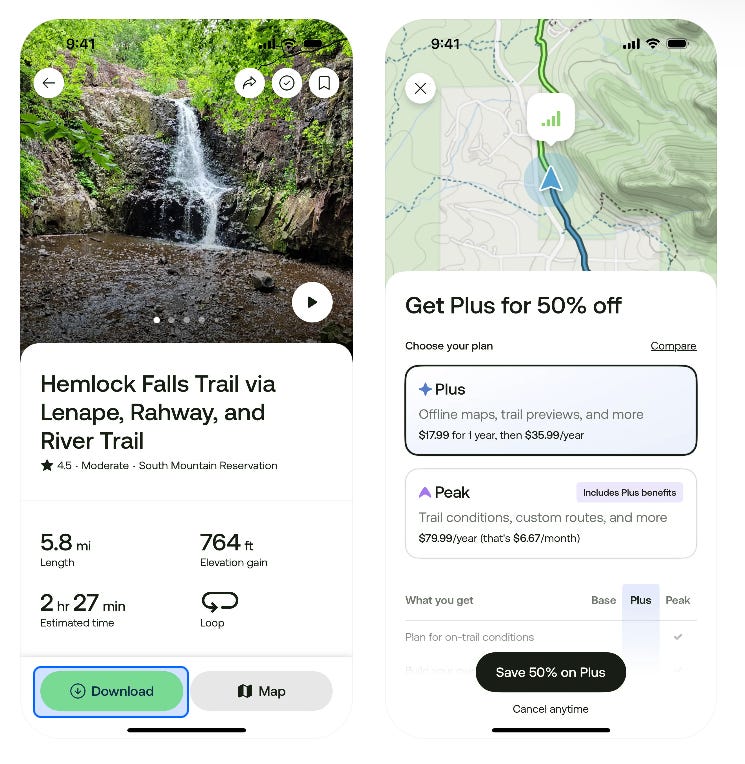
I remember signing up for AllTrails, the hiking app, when I lost connection to my offline map. I got a brief moment of signal in the middle of nowhere in Crete (minutes before I ended up being chased by wild dogs, but that’s a story for another time).
I tried to download the map, saw it was premium, and thought, “F** it.” I upgraded immediately — no way I was getting lost alone in Crete.
Here’s how their paywall works when you try to download a map:
Versus when you try to see the community heatmap (where others have walked):
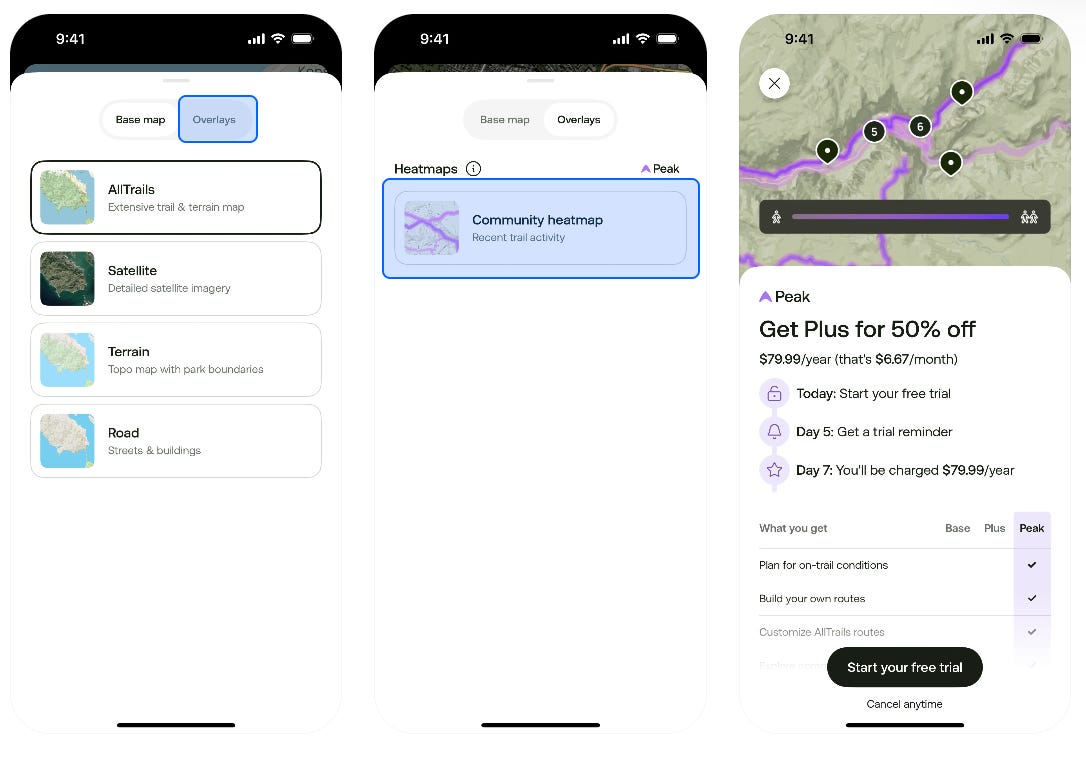
Different visuals and plans were pushed; it’s adjusted to the feature and the moment.
Combining context and a feature is a powerful converter.
How to think about paywall placement
A few questions worth asking when thinking about paywalls:
Where do users hit a wall? Look at where free users try to do something and can’t. Those are natural paywall moments. If you’re not surfacing an upgrade offer there, you’re missing high-intent conversions.
How many times does someone see your paywall? Some users need multiple exposures before converting. One interaction isn’t always enough. Check the percentage of free users who see a paywall per session.
Does your paywall match the moment? A generic “Upgrade to Premium” doesn’t work as well as “Unlock this route” or “Get unlimited hearts.” The more specific it is to what users are trying to do, the better the conversion.
Is it clear what is premium? This sounds obvious, but it comes up all the time: upgrade options buried in settings or hidden behind tiny icons. If users don’t know premium exists, they can’t buy it. Don’t wait for them to click through; make it obvious.
This isn’t about more paywalls, it’s about better
For smaller apps, yes, visibility often needs improvement. But for most, the bigger opportunity is matching paywalls to the right moments. Tools like RevenueCat Paywalls and Superwall.
When you align paywalls with features and context, users don’t feel sold to; they feel like you’re meeting their specific need.
Recommendation
In every edition of Growth Waves, I share a resource related to the week’s topic.
Jacob Rushfinn wrote a fantastic deep dive on dynamic and contextual paywalls, with concrete examples from Strava, Calm, and Duolingo. He also highlights how AllTrails handles this well and even includes a whimsical board of contextual paywalls.
If you’re looking for inspiration on making paywalls feel more relevant to user behaviour, it’s definitely worth a read.
I would also definitely recommend Vahe’s course.
The onboarding paywall gets attention because it's measurable, and it's where most trials start.
But for freemium apps, the paywalls that appear at moments of real need often convert the users who weren't ready on Day 0 — but are ready now.
Daphne