


Hi there,
I’ve been a fan of Jacob Rushfinn’s content for years. When I wrote my guide to price localization, I checked his research first. So when he updated it for 2026, I went back for his latest take.
If you care about app pricing (or learning about engagement, retention, and monetization), his newsletter Retention.Blog is one I’d genuinely recommend having in your inbox.

Right, on to pricing.
Quick question: who set your app's price in India?
If you’ve never opened that screen in App Store Connect, the honest answer is nobody.
Apple took your US price, ran it through an exchange rate, added tax, rounded it to a tidy local number, and that was that.
I’ll admit my first reaction to this research was personal. Living in the UK (and being Dutch, so I get it twice), I’m paying more than Americans for the same apps. Rude.
But the bigger issue is that none of these prices reflect what people in that country can pay, or how much they value what you’ve built.

Apple’s defaults aren’t neutral. They’re expensive.
When Jacob Rushfinn, co-founder and CEO of Botsi, looked at what successful apps actually charge, the gap with Apple’s suggestions was huge:
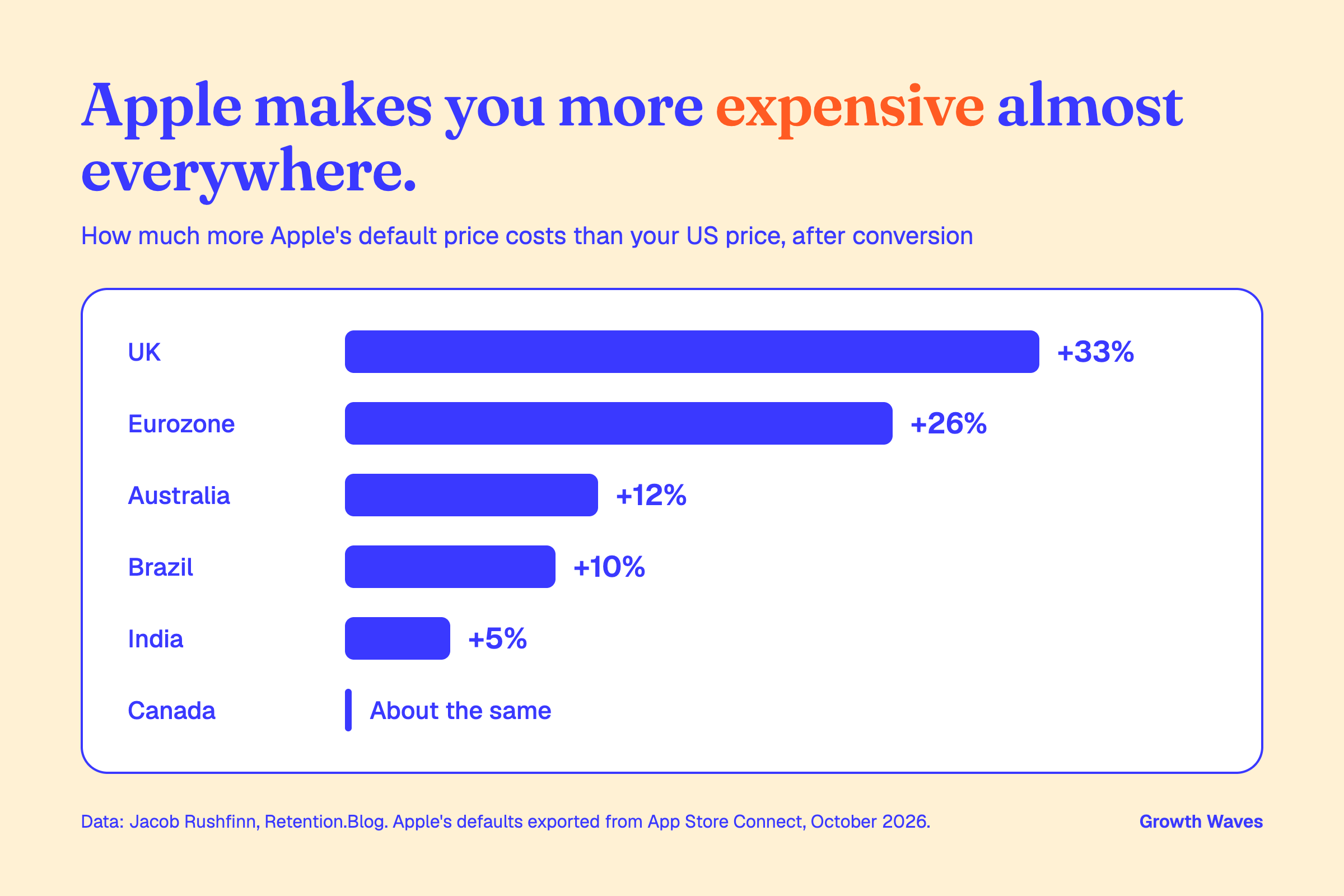
Only Canada comes close to the same price. Part of the gap is tax (local prices include VAT, US prices exclude sales tax); part is rounding to numbers like £9.99.
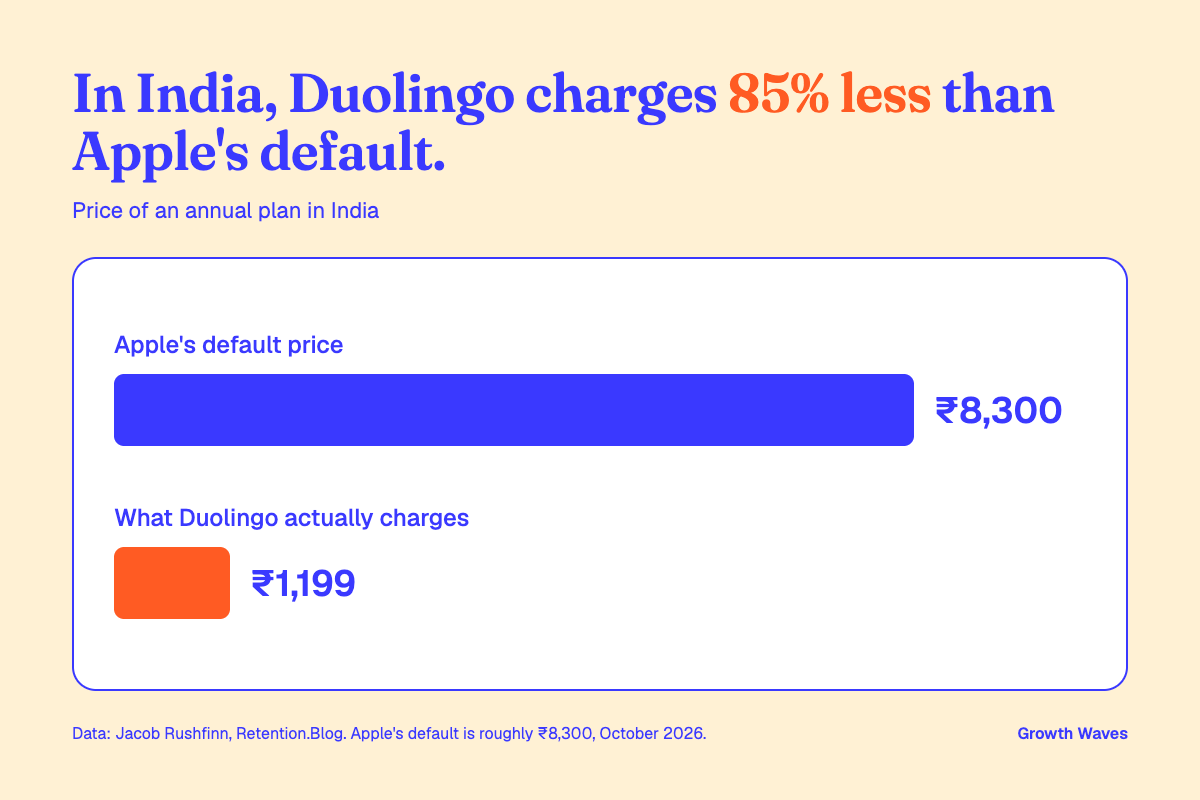
Now look at what the top apps actually charge. Duolingo’s annual plan in India is ₹1,199. Apple’s default would be roughly ₹8,300. That’s about 85% lower.
So if you’ve never touched your price tiers, you’re likely priced well above what people in those markets expect to pay, and well above what the top apps charge there.
In India and Brazil, an untouched price can be 2 to 3 times what the top apps charge.
The irony? We’ll spend weeks testing a paywall headline in our main market and never look at the price someone in Brazil or India sees.
And it gets worse every year you don’t look
This was the bit that surprised me most:
Of the 35 annual prices Jacob tracked in 2023, 29 are exactly the same today. Strava hasn’t changed a single one.
Currencies didn’t sit still, though. Since 2023, the pound is up 6% against the dollar, and the rupee is down 13%.
So prices nobody touched got more expensive in Europe and cheaper in emerging markets. Again, without anyone deciding that.
And when top apps do override Apple, they almost always go down. Across 2,433 local prices from 18 top-grossing Education apps:
45% sit at Apple’s default
41% are priced below it
Only 14% are priced above it
Localization in practice mostly means discounting.
The 5-minute check
You don’t need a huge, elaborate pricing project to see whether this matters to you.
Open RevenueCat (or App Store Connect) and pull two numbers for your top 10 markets:
Download to paid conversion
Revenue per install (or ARPU)
Then look for the outlier.
Jacob’s example: if your conversion rate in India is five times lower than in Canada, Australia, or the US, your price is probably the problem. Remember, Apple’s default there is higher than the US price, while Duolingo charges 85% less.
Same terrifying green owl, different price tag.
If you’re not sure where to look first, start with markets that have lots of free users but few paying ones.
Then ask one uncomfortable question for that market: did anyone on your team actually choose this price? If the answer is no, you’ve found your starting point.
It’s not just about going cheaper
This is where people get it wrong. Localization means pricing your product based on how much it's worth to people in that market. Sometimes that means charging more.
Look at Europe, where the top apps have split into two camps.
Duolingo charges more in Europe than in the US (€94.99 in France against $83.99).
As Jacob points out, the product is worth more there because learning English can open up better job opportunities.
Calm and Strava go the other way, sitting 30% to 45% below Apple’s default.
Both work. Your own conversion data tells you which camp you’re in.
Sometimes the answer isn’t a different price at all, but changing which plans you offer:
Impulse, the brain training app, dropped its annual plan in Brazil. Everywhere else, it offers weekly, annual, and lifetime plans. In Brazil, annual is gone from the paywall entirely.
And a lower price can still mean more profit. Flo cut prices in Brazil, and it became their third-largest market. It stayed profitable partly because ads were cheaper there too. Your price and your acquisition costs move together, so judge the market on both.
Before you go and change 40 prices
Full transparency: this isn’t for every app.
If almost all your revenue comes from one market, fix that price first (remember the pricing framework I shared before).

Otherwise, every other market is a smaller version of the same problem, and you’ll benchmark against it anyway.
And when you do test, go bold. Don’t test $39 versus $43. Test $39 versus $69. Then give it 3 to 6 months, because the real answer lives in retention and LTV, not week-one conversion.
💡 What I’d recommend this week
Subscribe to Jacob’s Retention.Blog.
Everything new in this issue comes from Jacob; he is also the founder of Botsi, an AI Pricing tool for consumer apps, so he has real-time insights into how consumers react to different prices in different situations.
He also runs the Price Power podcast, which I listen to regularly.
And this week you’ll find me in there too. I wrote a guest issue for him on the 5 steps I use to find an activation metric that actually predicts retention.
Not sure you’ve priced your app right?
Use the calculator Jacob built to see what you should charge per market based on your category and pricing strategy.

The default price is a decision nobody made, and it’s often wrong. So make it yours.
Till next week,
Daphne