


Hi there,
When it comes to product diversification, founders often swing to one of two extremes:
Those that diversify too soon -> Premature Diversification/Overextension.
They jump into new products too soon before fully leveraging what’s already working.
Those who wait too long to diversify -> Stagnation.
They hold off for too long, which can slow momentum and stall growth.
Today, we’re zeroing in on the first one: diversifying too soon.
We’ll walk through five key questions to help you assess whether now is the right time, so you can focus on Strategic Expansion, not overextension.
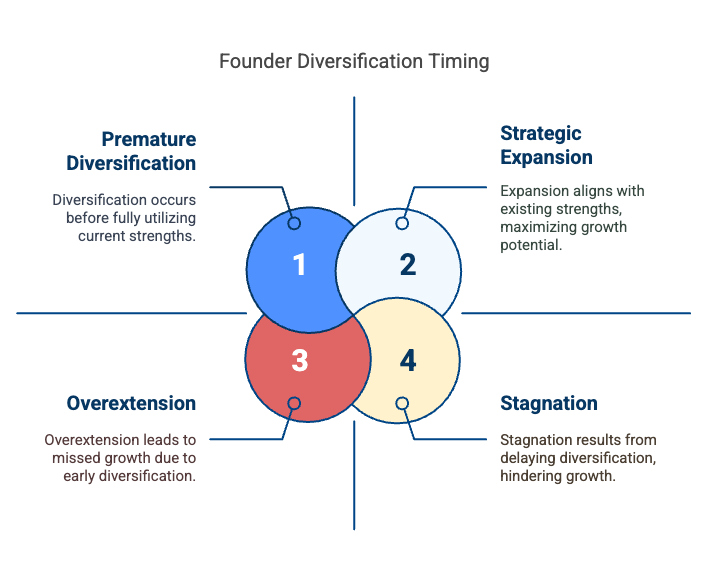
Why do founders diversify too soon?
Founders are natural innovators. New ideas are exciting, and building new products can be energising. It’s easy to get swept up in that momentum.
But at the end of the day, product diversification should be a growth strategy, not just a creative outlet. New products can give you a short-term boost, but they’re resource-intensive and won’t solve deeper issues in your business.
That’s why it’s crucial to pause and check: Are you expanding strategically, or just chasing the next shiny thing?
Ask yourself these five questions first
1. Have we maximised opportunities with our core product?
Are we still acquiring customers profitably?
Is demand still growing, or has it peaked or slowed down?
Have we optimised retention, AOV and LTV?
If not, adding products may just distract from the real bottleneck. The exception is when you need to pivot because your initial product won’t reach product-market fit, but I see that as a different category.
2. Do we have a loyal and engaged customer base?
Again, signals of retention (high repeat rates, positive reviews, and customers actively sharing feedback) are key.
Initially, you ideally want to offer products to your existing or adjacent customers, so signs of loyalty are key. Which is why point three is vital.
3. Does this new product naturally align with our current offering?
Your customers buy from you for a reason, such as to sleep better or have more energy. You want to offer products that match the same Job to Be Done as your initial product.
AKT started with a single product: their natural deodorant. They first expanded by introducing new scents of that same product, deepening their appeal without overextending.
Once they had built a loyal customer base, they launched a complementary body care line—Body Wash and Body Conditioner—in the same signature scents. This gave customers more ways to experience long-lasting, natural protection while staying true to the brand’s core promise.

4. Are we solving a real customer problem, or just adding more stuff?
Back when I was Head of Growth at Heights, a braincare company, there was a moment when we considered launching an app to add a digital layer to the experience. But when we paused to ask, what real problem would this app solve for our customers? The answer wasn’t clear.
Years later, Heights still doesn’t have an app, and I think that was the right call. The idea was driven by internal ambition, not customer insight.
Before launching something new, ask yourself: What pain point is this solving?
Sometimes, the answer is simple and grounded. For example, releasing new flavours can help existing customers fight flavour fatigue and stick with your product longer.
Strategic expansion starts with solving real problems and not just adding shiny features.
5. Are we clear on the opportunity cost of this expansion?
Every new product demands time, attention, and resources—and that focus has to come from somewhere.
You also need to consider whether you have the operational capacity to support the expansion, without losing focus on our core business.
Trying to roll out five new products at once? That’s a fast track to overwhelm. Your day-to-day doesn’t pause just because you’re launching something new. Without clear focus, everything new and existing suffers.
Recommendation
Every week, I recommend a relevant resource to learn more about the topic.
While putting this newsletter together, I came across several insightful articles on product diversification. These three stood out the most, and are well worth a read if you’re thinking about expanding your range:
How product managers can impact product diversification (Product Led Alliance)
How Expanding Your Product Range Can Benefit Your Business (Shipbob)
So, if you're thinking about expanding your product range, sit down with your team and ask yourselves these five questions:
Have we maximised the opportunity with our core product?
Do we have a loyal and engaged customer base?
Does this new product naturally align with our current offering?
Are we solving a real customer problem, or just adding more stuff?
Are we clear on the opportunity cost of this expansion?
If you can confidently answer yes to all five, then it’s time to go full steam ahead.
Till next week,
Daphne