


Hi there,
A limited growth budget can be a good thing.
It forces you to make choices, get creative and really focus on your product. To not get comfortable with the money of investors, but challenge yourself.
I know, I’m really trying to look on the bright side here. I’m definitely not saying it is easy to grow. Rather that some of the best D2C brands I’ve seen grown have done it with little to no funding.
So let’s stay on the bright side and cover eight practical tips for when funding is low.
1. Limit the number of channels you are testing
In an early stage startup, a high proportion of your budget will go to testing, which is ok.
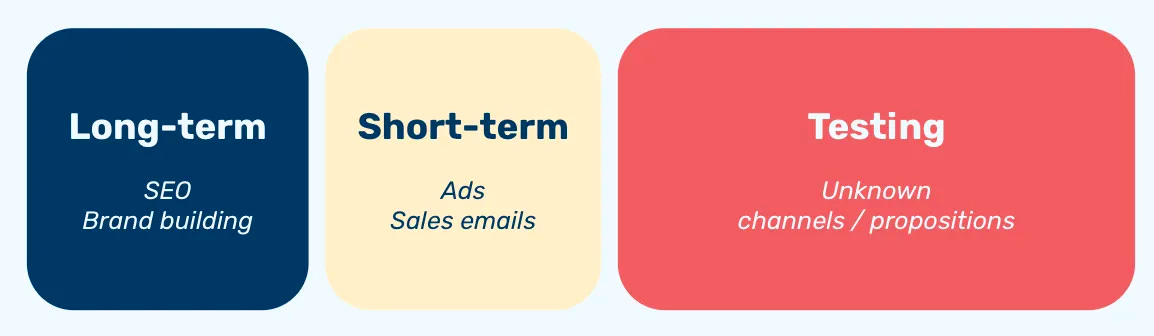
Activity division of a startup
But try to test only a few channels simultaneously to ensure you can get the most out of your budget.
Think about the Cost of Acquisition (CAC) to the daily budget.
You should be able to get multiple conversions per day to learn whether that channel is or isn’t performing.
2. See time as money
When calculating your CAC, include the time spent per hour (work out an average cost per hour):
Cost of team + tooling + spend = Actual cost of acquisition
Work this out to make sure what can appear like a cheap channel (organic social media) isn’t secretly stealing away all your time and resources from more effective channels.
3. Don’t go too quickly to big brand awareness channels
Many brands jump to test podcast ads, PR, offline, and big influencers before they get to product/market fit, thus failing to get messaging correct.
Try to test your messaging in a smaller setup first.
4. Don’t be afraid to ‘kill’ channels
Let’s say your Cost of acquisition (CAC) is 4–5x what it needs to be:
Small changes aren’t going to get it down to £20
Instead, try something drastically different or focus on a different channel.
5. Have a budget for mentors
You can’t be the best of the best in every area when you are small, platform such as GrowthMentor is well worth the investment to ensure you can test channels properly.
Good mentors give you an outside perspective and ask challenging questions. They force you to stop working just in the business but on the business.
6. Consider lesser-known channel
Mature channels like Meta ads and Google ads tend to be more expensive compared to emerging channels or lesser-used channels. Look where your audience is and don’t be afraid to test other platforms.
Whenever I’m evaluating channels, I’m consistently scoring them on “ability to compete” as one of the factors in order to take competition into consideration: I score channels higher with less competition.
7. Use tools to get the most out of your budget
There are incredible tools that can be a huge time saver; however, some may be expensive. However, if you follow the rules listed in tip two, you will see they are worth the investment.
Think attribution tools, landing page buildings and more.
8. Look for sustainable sources of growth
When you start growing a new startup, you will use linear channels to gain initial momentum and test channels out.
From there, focus on finding potential growth loops that will build momentum rather than constantly investing in one-off campaigns/growth opportunities.
For example, once you have an initial user base, you can build in a viral loop to gain more customers by word of mouth.
-
Recommendation
In every edition of Growth Waves, I also share a related book, individual or newsletter to check out related to the week's topic.
As a mentor on Growth Mentor, (I reserve 3 - 4 hours per month to give free advice to small startups) I can gift free mentor sessions (the session doesn’t have to be with me, it can be any mentor on the platform).
So if you are feeling a bit stuck as a small startup, just reply to this email and I’ll send you an email invite to use a free session.
I only have three free sessions I can gift per month so it will be first come first serve.
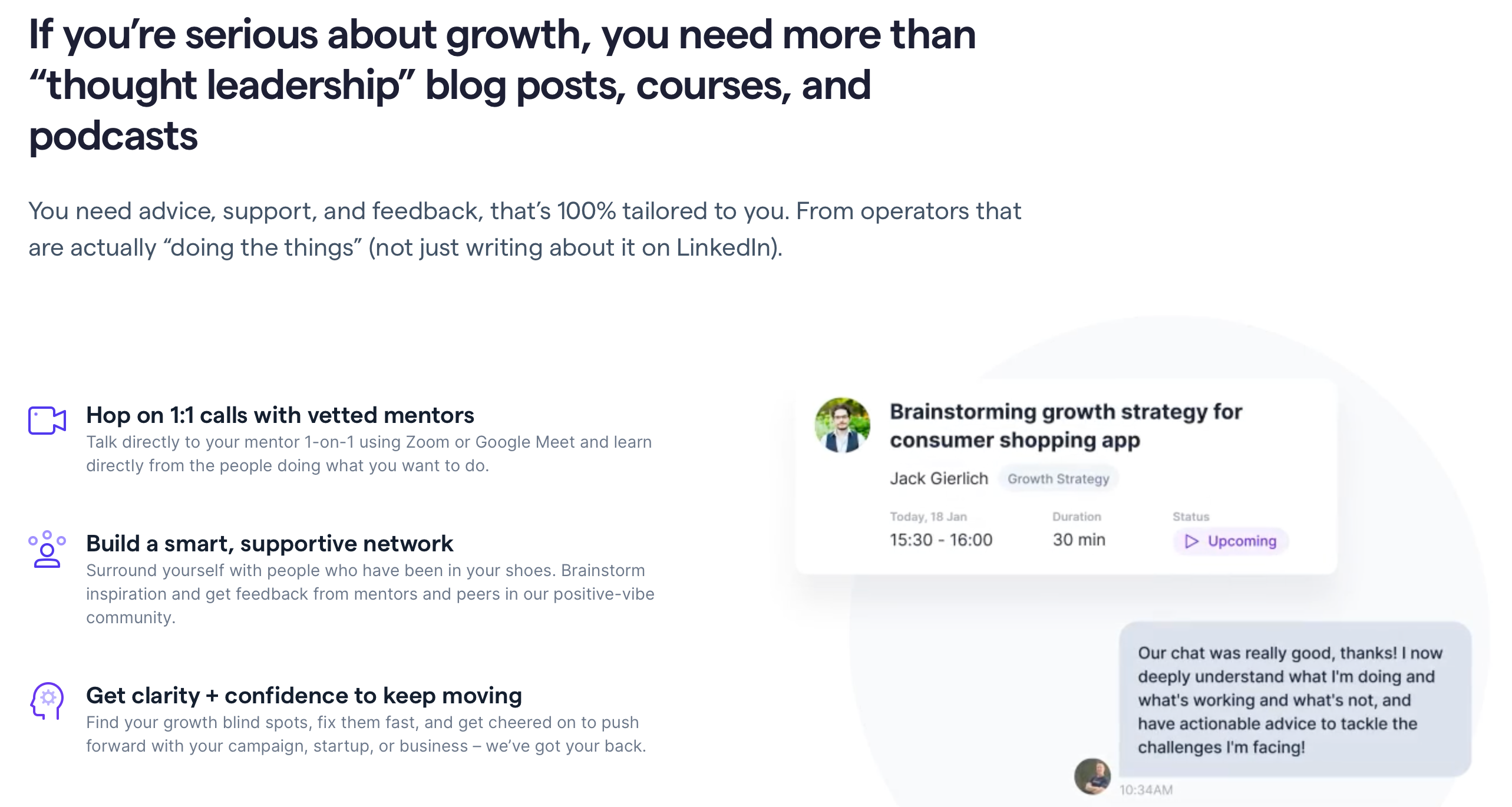
GrowthMentor is a great platform to help you build out your support network as an early-stage startup.
–
I hope this has inspired you to embrace your lower budget/bootstrap and let it challenge you to build a stronger business. If you choose to go for funding at a later stage, you’ll make much greater use of that budget.
Till next time,
Daphne