


Hi there,
I was helping a client work through their annual targets recently, and realised I had a lot of opinions about this.
Not about the numbers themselves — but about how we think about targets in the first place. Because I’ve seen firsthand what happens when target-setting goes wrong.
Too ambitious, communicated to investors as commitments, and suddenly the team is demoralised after two quarters of “failure” — even when the underlying business is healthy.
Too cautious, always exceeding, and everyone starts wondering if you’re actually pushing yourselves.
The difference between a motivating target and a soul-crushing one often comes down to a few decisions made in a spreadsheet months earlier.
The problem with “if everything goes right” targets
Most growth targets are built on assumptions. If the new product launches on time. If the marketing campaign performs. If the supply chain holds. If competitors don’t do anything unexpected.
But nothing goes 100% to plan:
Development delays
Competitors launch
App stores reject your latest version
When your target is “what we could hit if everything works,” you’re not setting a target. You’re setting an ideal ceiling you’ll probably miss.
The correction I always recommend
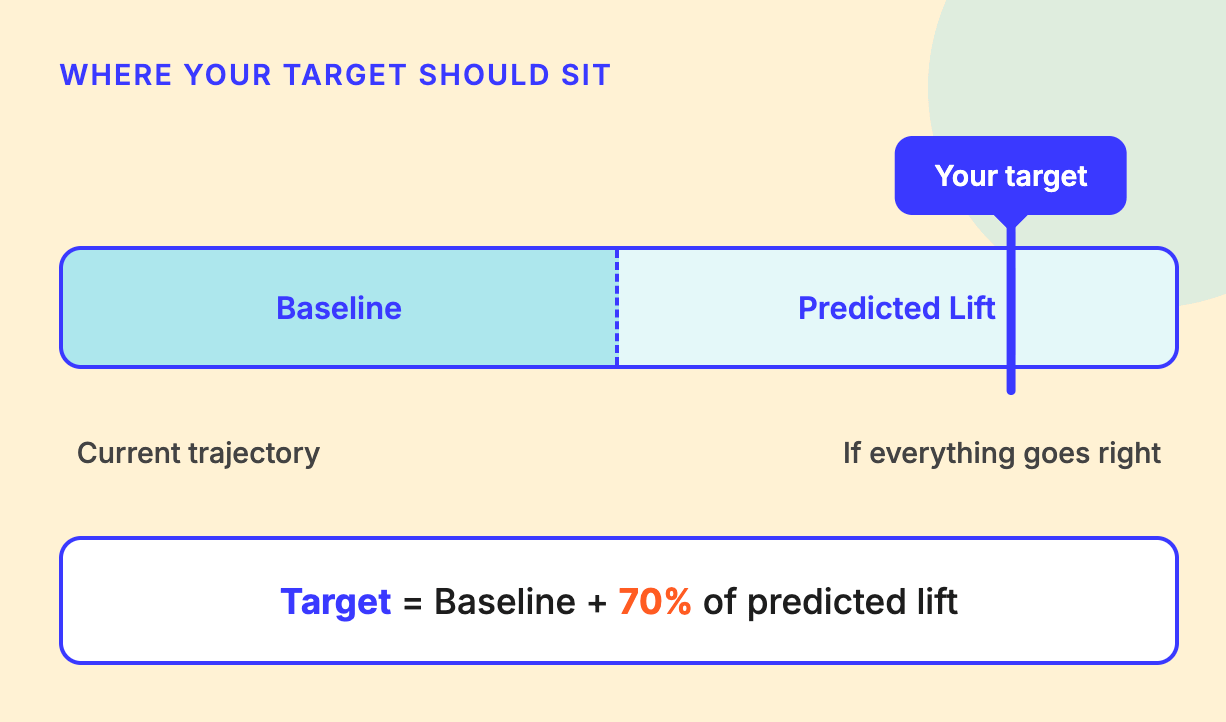
Start with your baseline:
The growth you’d expect based on your current new and returning customer/subscriber rates, assuming no major changes, e.g., depending on the month, this could be 4% growth one month, 6% the next month.
This is what happens if you just keep doing what you’re doing.
Then calculate your adjusted target:
Baseline plus all the upside from new initiatives, launches, and optimisations. These are set per month and adjusted for delays to ensure targets don’t remain the same when projects/hires are delayed.
The target you actually commit to? Somewhere in between.
I usually opt for the following formula:
Baseline + 70% of the predicted lift (% can be adjusted based on how optimistic/pessimistic your team is).
This isn’t pessimism.
It’s acknowledging that not every initiative lands exactly when and how you expect.
The 30% haircut accounts for timing slips, things that don’t work, and factors outside your control, while staying ambitious.
Why targets are so hard to get right
Here’s the uncomfortable truth: the more variables in play and the shorter your history, the less accurate any target will be:
Early-stage businesses are forecasting with limited data.
Seasonality is still a guess.
You don’t know how that new channel will perform or whether the product/feature launch will slip by three weeks.
Every variable you add — new markets, new partnerships — compounds the uncertainty. Your H2 targets, set in January, might be little more than educated guesses as a startup.
This doesn’t mean don’t set targets. It means hold them loosely, build in recalibration points, and don’t treat a miss as failure when the forecast was always uncertain.
Who sees which number matters
This is where I see founders get into trouble.
Google’s OKR philosophy says aim high, expect to hit 70%, and that’s success.
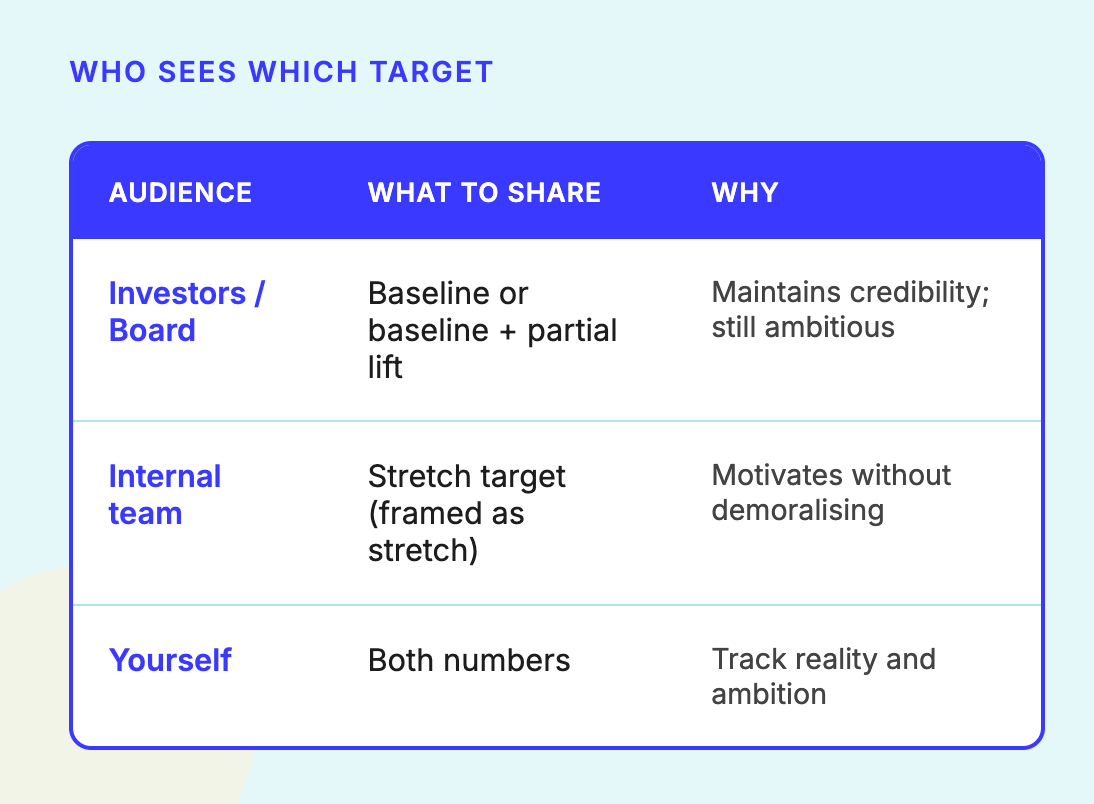
But that’s for internal stretch goals within a culture that understands the game. It doesn’t translate to board meetings where hitting 70% of your forecast looks like failure.
My rule of thumb is as follows:
The most valuable part isn’t hitting the target
Here’s what I’ve learned: the target itself matters less than the reflection afterwards.
Did you hit it? → Great — what drove that?
Did you miss? → What assumptions were wrong? Which initiatives underperformed and why? What would you do differently?
That reflection is how you learn what actually works in your business.
It’s how your forecasts get more accurate over time. It’s how you stop repeating the same mistakes.
A target you hit without understanding why teaches you nothing. A target you miss but learn from is genuinely valuable.
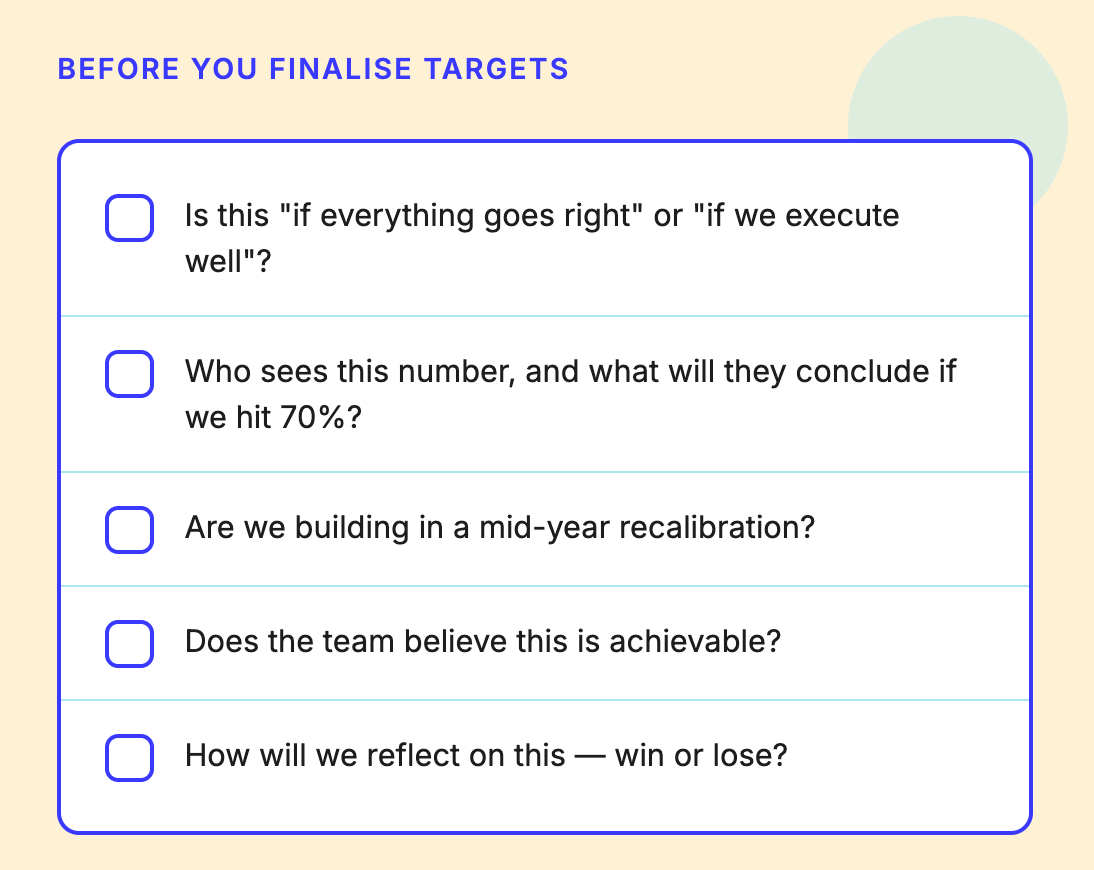
A few questions before you finalise
Having discussions internally about how targets are understood is so important. I really wish I’d done this more at the start of my career:
Target-setting feels like a spreadsheet exercise, but it’s really a communication exercise.
Get that communication right, and targets become useful. Get it wrong, and they become a source of friction and burnout.
It’s worth getting right.
Till next time,
Daphne