


Hi there,
Back in my agency days, my alternative job title was H.O.R.S.E.: Head of Random Sh*t Everyday.
It was a joke about me, but it was also a pretty fair description of the average Head of Growth spec in 2022.
Run the growth strategy, own experimentation, and manage about five channels, including offline, SEO, and paid ads. It was so easy to say, “That impacts growth, let’s stick it under the Head of Growth role.” By that logic, just about everything could fall under the role.
I analyzed six of those specs back then and complained loudly. This summer, I reran the analysis on 20 live job postings.
The job hasn’t evolved. It has split.
Channels have fallen out of the spec. PPC went from every single role to 40%, and SEO from 67% to 15%. But four things held:
Growth strategy
Conversion KPIs
Data analysis
Experimentation.
The channel execution has moved elsewhere. What stayed is the method for figuring out what’s actually true.
So which of the four are you hiring?
That same title now pays £70k at one company, and £250k at another, and the gap isn’t seniority. It’s that four different jobs are wearing the same name.
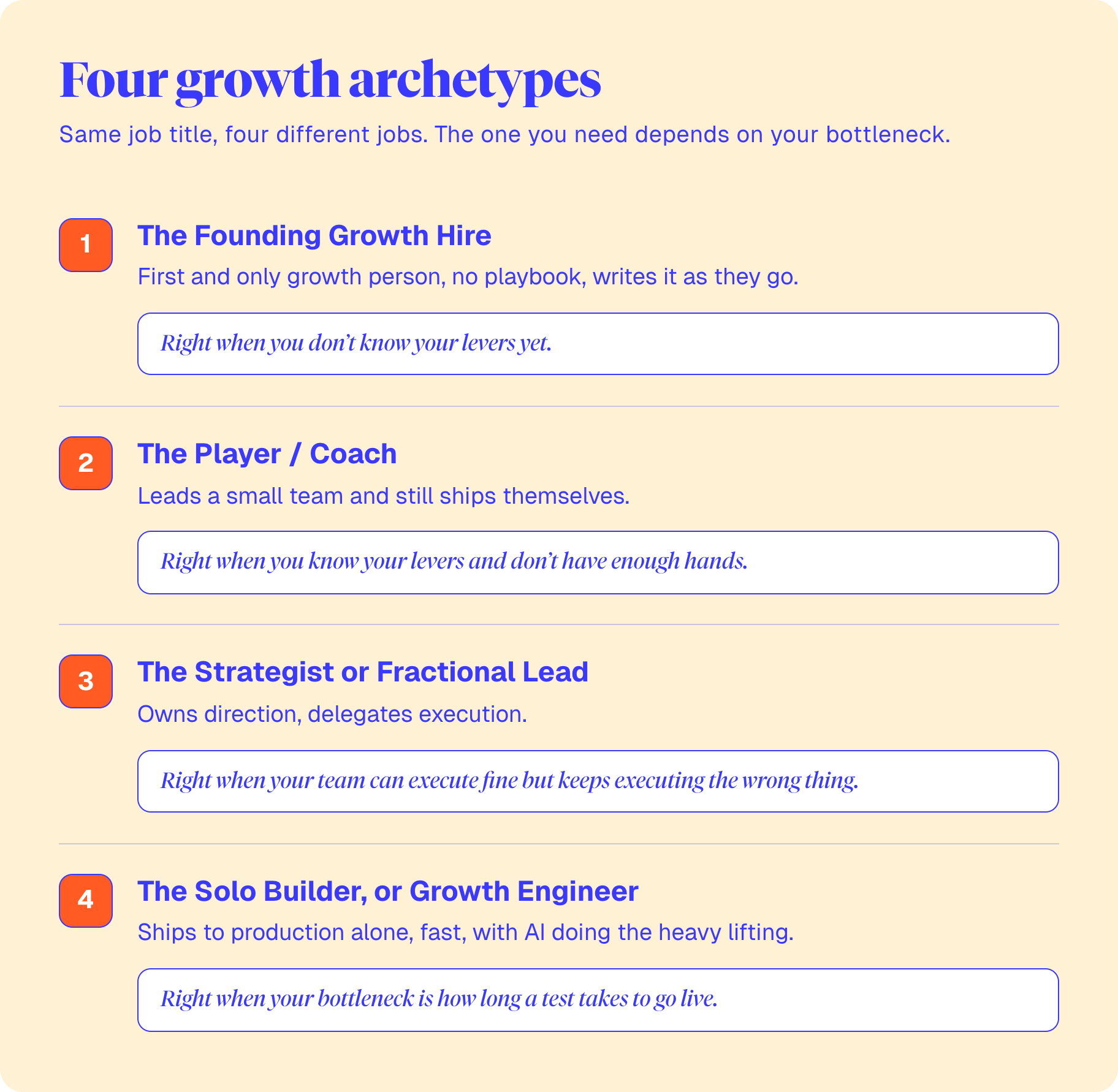
Here’s the question I’d ask before writing a single line of the spec: What’s actually slow right now: the deciding or the doing?
If deciding is slow, a builder just makes you faster at the wrong thing. If doing is slow, a strategist gives you a better plan you still can’t ship.
Most founders I speak to write the spec for all four, then feel let down by whoever they hire.
Which isn’t a hiring problem. It’s the H.O.R.S.E. problem with better formatting.
(I’ve done the same thing from the other side of the table, pushing back when a spec got too broad and started asking for lots of brand and marketing experience: “If you’re looking for a Head of Marketing, I’m not the right person.”)
There’s one more shift worth paying attention to, because it changes what you should measure the hire on:
Retention went from a third of specs to half.
Incrementality, MMM, and attribution went from zero to 35%.
Growth has finally stopped meaning acquisition for a lot of companies. For you, that means the roadmap no longer ends at purchase, and neither should the targets you set for this hire.
The longer version
I wrote up the full analysis for Convert: every category that left the spec, every one that entered, what changed in the attributes, and the four archetypes side by side, including the skills each one actually needs.
It also gets into the part I find most interesting: what this shift means for experimentation.
Experimentation is the one hands-on skill that survived the purge intact. And it’s now expected of a more senior — and considerably more expensive — person than it was in 2022.
💡 What I’d recommend this week
Convert is sponsoring this newsletter. If you’re running experimentation inside a team being reshaped by all of the above, their blog is worth a browse.
It’s one of the few places writing about the practice of experimentation, rather than just the tooling, and worth reading even if you’re happy with your current testing setup.
I’ve also written a related piece for them on how to decide between hiring an agency, a freelancer, or building an internal CRO team.
Funnily enough, being freelance and with the rise of AI, some days I still feel like the H.O.R.S.E.: Head of Random Sh*t Everyday.
The difference is that, while it can still feel random, those areas now align much more with the work I actually love and enjoy.
I’ve managed to find my own version of the Head of Growth role — and thrive in it — even if the scope can still be a wee bit broad at times.
Speak soon,
Daphne
Retention going from a third of the specs to half is the shift that quietly changes the hire's first week.
Because that target is not readable where the channels are. Platform conversions are modelled, capped by consent and scoped to a purchase window. Repeat rate and margin live in the customer system, and nobody hands those to a new starter by default.
So the question before the spec is which number the hire gets judged on, and who already owns it.
Retention going from a third of specs to half is the shift I can see from outside the company. Everfit's sign-up took me 93 seconds. Then getting to what a client actually sees meant a second device, an app download and a password I never created. The part before sign-up clearly had an owner. The part after didn't seem to.