


Hi there,
Working with wellness apps, you often find yourself in annual-plan heaven: 60–80% of subscribers on annual plans.
That’s not surprising. According to RevenueCat’s State of Subscription Apps 2026, Health & Fitness apps average 68% annual subscriptions, compared with 34% across all industries.
So whenever I see an app with a low annual-plan uptake, I want to stop and ask two questions:
Should it be lower?
If not, what’s holding it back?
Because a low annual share isn’t necessarily a problem. But it is worth investigating.
If you think your app is missing the mark on annual subscriptions, here are four steps to take.
Step 1: Do people even use your app long-term?
Let’s start with the uncomfortable question. If your app solves a short-term job (planning a wedding, getting through exam season, completing a six-week programme), nobody is going to commit to 12 months. And they shouldn’t be expected to.
No amount of paywall optimisation will fix that. If this is your app, annual isn’t your lever.
Your quarterly, monthly (or even weekly) plan is. And that’s not a failure.
Focus instead on optimising those experiences and getting them on the longer version of what is realistic (if there is one).
Step 2: Does your market actually prefer annuals?
This one gets overlooked constantly. Annual uptake varies not just by geography, but by age, too.
Anecdotally, I see Gen Z skew towards shorter plans time and time again. And I’m not the only one. Back in 2023, Tinder’s CEO said that younger users had “more of an affinity to lower price and shorter-term duration products” than they’d expected. That’s one reason Tinder leaned further into weekly plans, and now most apps offer weekly plans.
Commitment phobia, but make it subscriptions. Ironic for a dating app. But I guess it is also sweet optimism; no one wants to believe they’ll still need a dating app in a year’s time.
So if your audience is young, or your users are concentrated outside North America and Western Europe, your supposedly “low” annual share might simply be your market telling you something.
Step 3: Are you making annual attractive enough?
If you’ve made it through steps 1 and 2 and still think you should have more annual subscribers, it’s time to look at the offer.
Here are three things I’d consider testing.
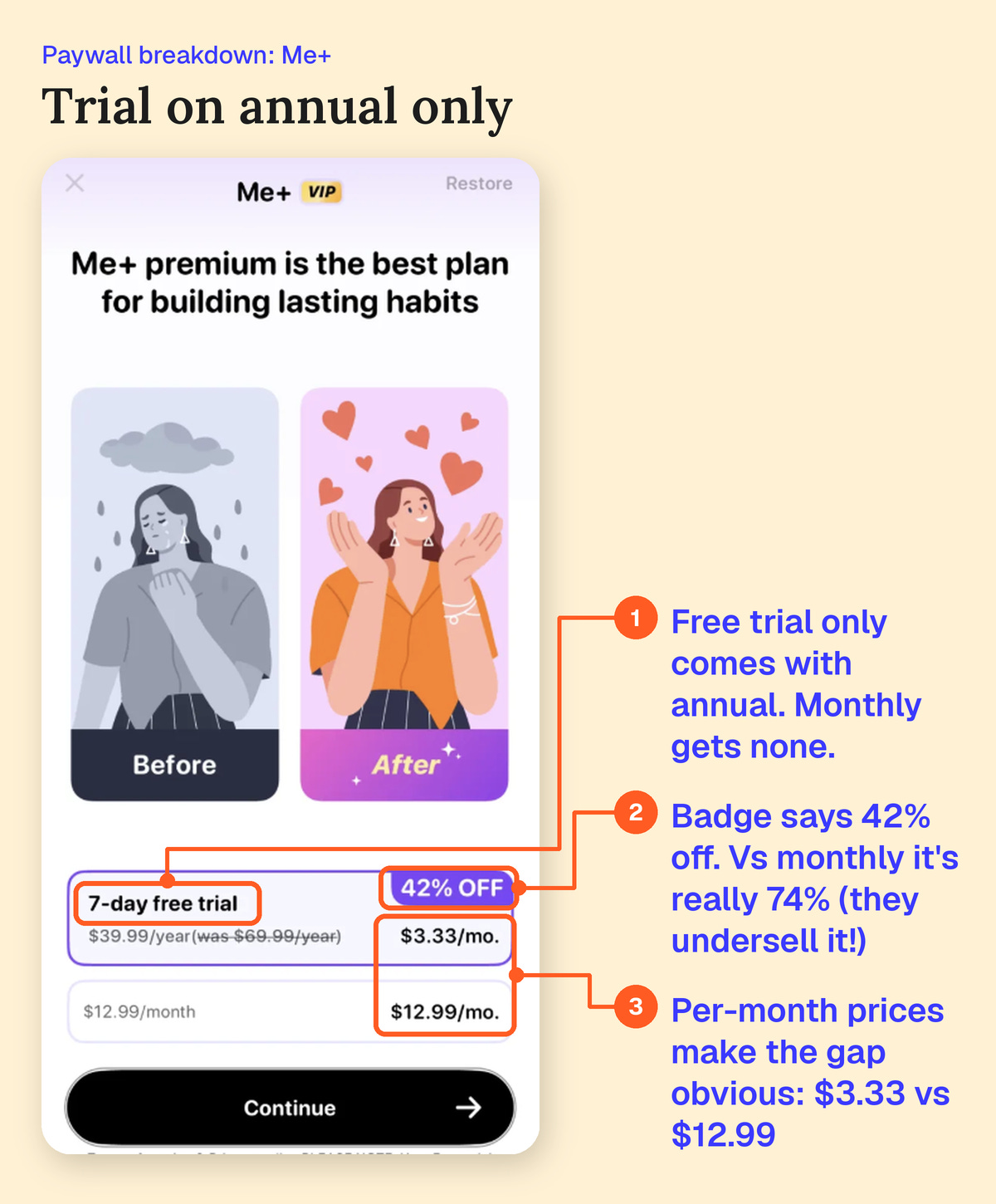
Experiment idea 1: Put the free trial on annual only
This is a common tactic, and it can work well. The free trial becomes a reason to choose the annual plan, rather than a nice extra available on every plan.
Experiment idea 2: Make the price gap meaningful
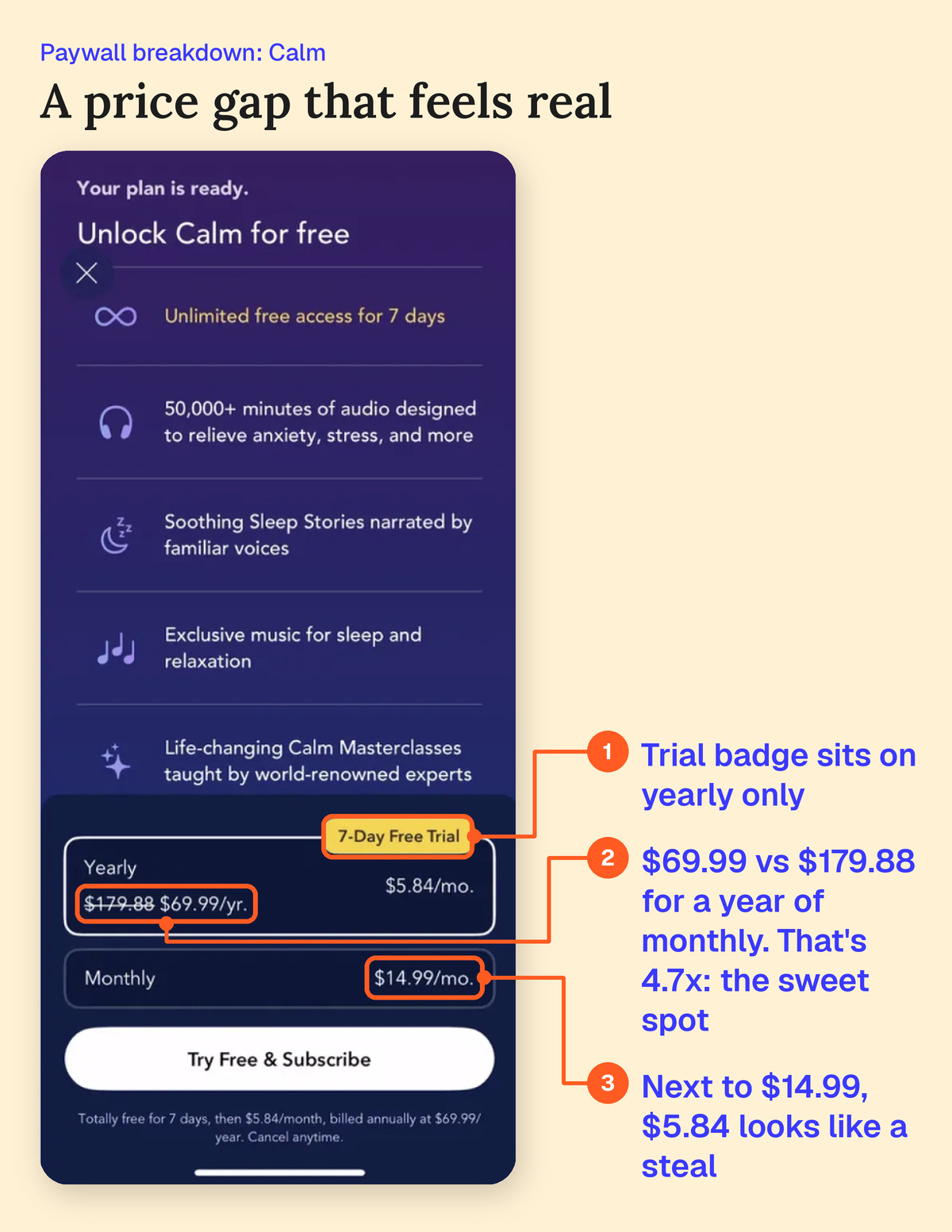
My sweet spot is an annual price roughly 4–6 times the monthly price. That’s equivalent to a 50–67% discount compared with paying monthly for a full year.
For reference, the median app sits at around 3.5x ($10 monthly vs. $34.80 yearly in the SOSA data), while Health & Fitness is right around 4x.
If your annual plan costs 9 or 10 times the monthly price, the “deal” barely feels like a deal.
One important caveat: measure cancellations and longer-term revenue when testing price changes. Push the annual price too high, and the resulting churn could wipe out any gains.
Experiment 3: Make the value obvious on the paywall
Full transparency: I would NOT start by hiding the monthly plan.
Some apps do this, and it can increase annual share, but it’s a pretty blunt instrument. I’d save it for later.
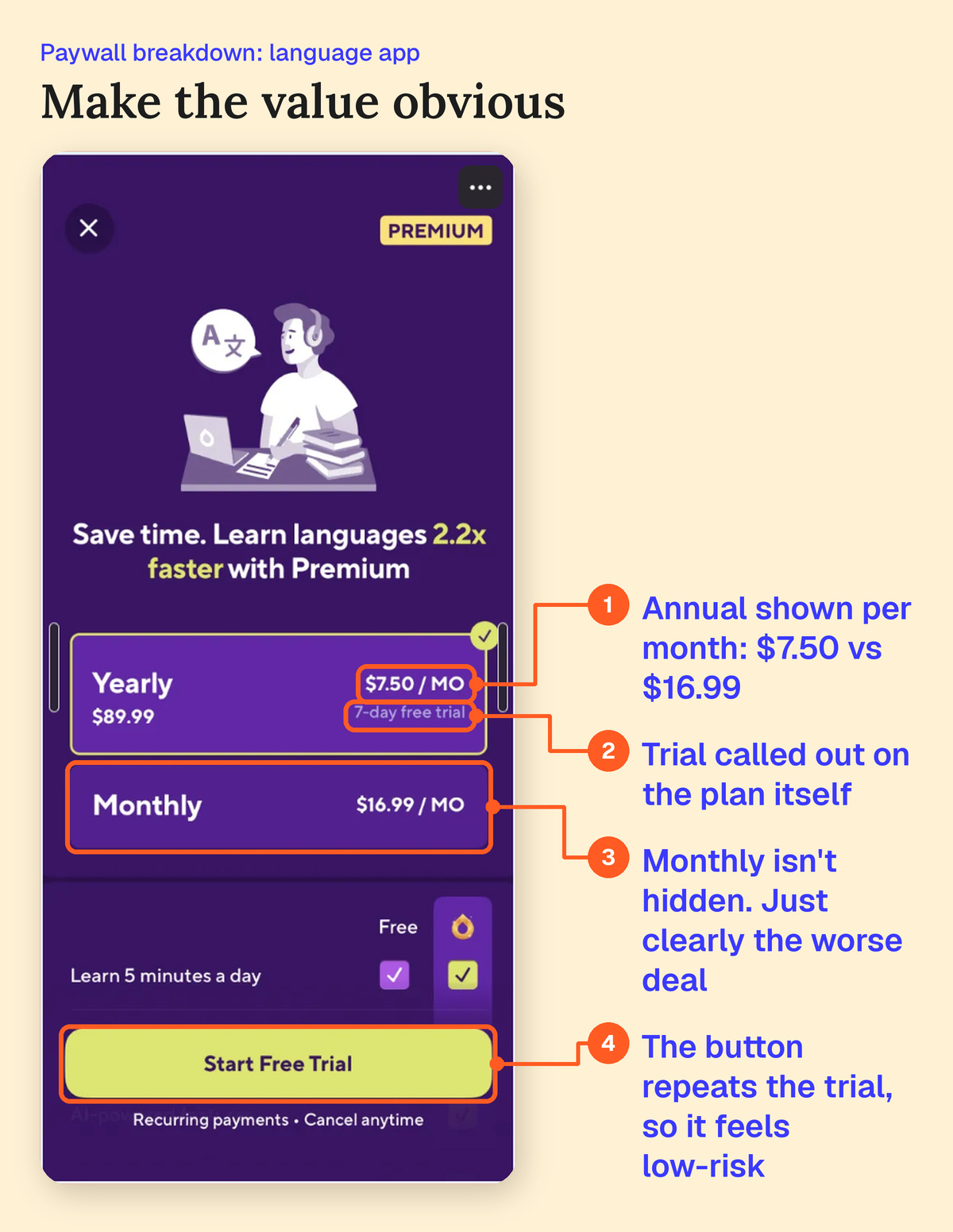
First, make it painfully obvious why annual is the better choice. Does it include the free trial? Say so. What does it work out to per month? Show it.
Too many paywalls I review bury both.
Step 4: The one nobody looks at (onboarding)
This is the step I’m most convinced about, and the reason I wanted to write this issue in the first place.
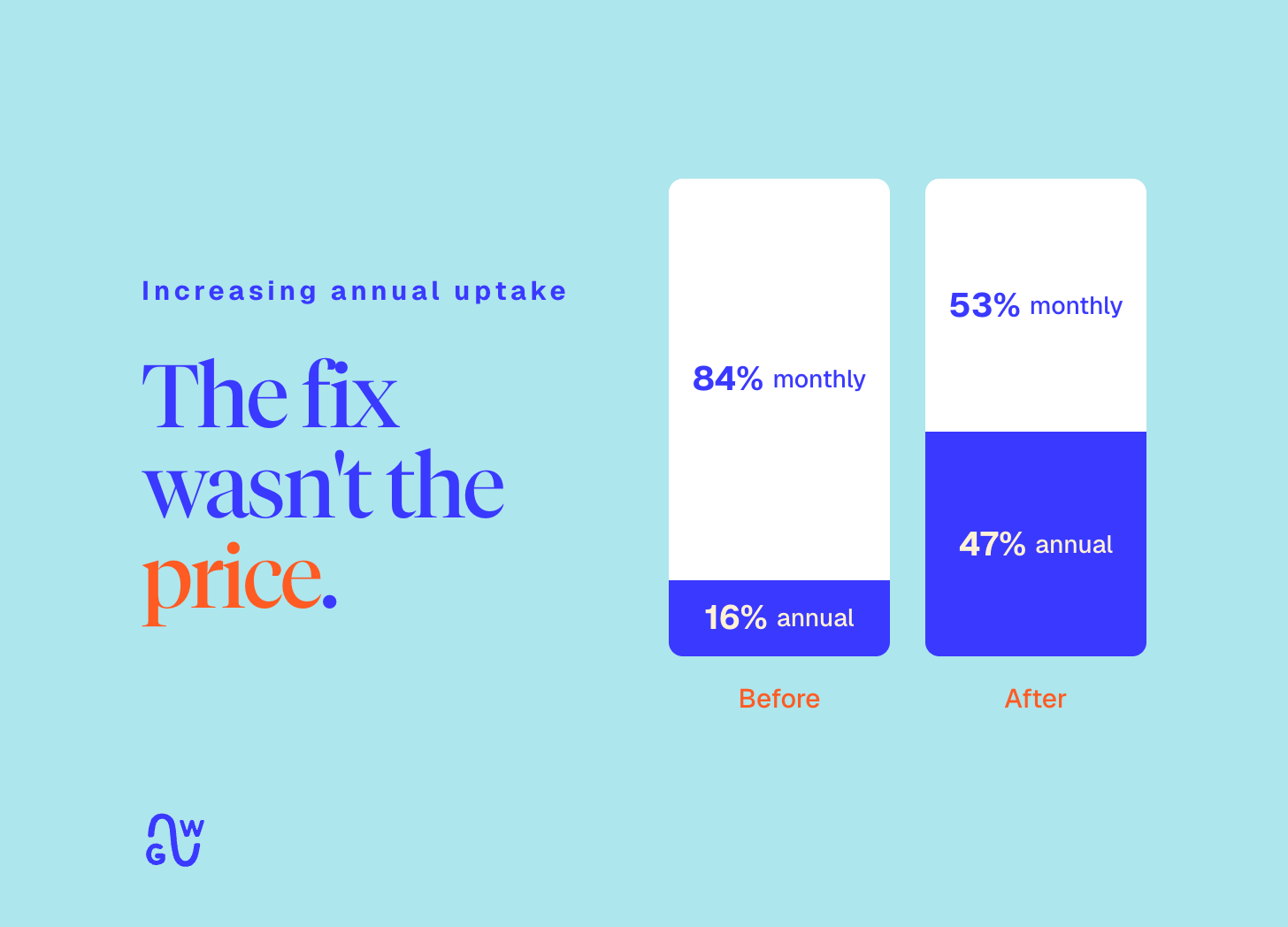
Last year, I worked with a wellness app whose audience leaned heavily towards monthly subscriptions. In Q1, just 16% of subscriptions were yearly.
We made changes over the summer. Most of the work went into positioning and onboarding: guiding users more effectively through the flow and building trust before they reached the paywall.
By Q4, 39% of subscriptions were yearly.
Given that the app had a meaningful short- to mid-term usage segment, getting to 80% annual subscriptions was never realistic. But this was already a huge win.
And here’s the irony: the monthly price change didn’t go live until January. After that, annual share climbed further, reaching 47% the following quarter, without a significant drop in conversion.
The majority of the improvement came from guiding people better and building trust before they ever saw a price.
It wasn’t all up and to the right, either:
Trial-to-paid conversion actually dropped from 74.4% to 64.4%.
But registration-to-trial conversion increased from 9% to 20.3%.
Overall paid conversion more than doubled, from 6.6% to 13.7%.
I’ll take that trade every day.
I’ve seen this pattern in other experiments, too. Stronger onboarding doesn’t always improve every individual conversion metric. But it can change which plan people choose.
When people trust that an app will actually help them, they’re much more willing to commit to a year.
It makes sense when you think about it. Choosing annual is a bet on yourself and on the app. If your onboarding hasn’t convinced users that you understand their problem, why would they make that bet?
💡 What I’d recommend this week
If you went through steps 1 or 2 and realised annual just isn’t right for your audience, please don’t panic.
I wrote a whole article for RevenueCat on when monthly plans are actually the smarter choice. It covers the markets and age groups that tend to prefer them, and why monthly subscriptions can tell you more about product-market fit than annual plans ever will.
It’s the flip side of this issue, and a good reminder that a low annual share isn’t always a problem to fix.
Sometimes, it’s the honest signal you needed.
So, where do you start?
Not with the discount. I’d work through these in order:
Check usage. Is your app a long-term habit or a short-term job?
Check your market. Compare your annual share with your category, region and age group.
Check your offer. Consider testing a free trial on annual, a price ratio of roughly 4–6x, and clearer value messaging on the paywall.
Check your onboarding. Are people reaching the paywall convinced your app is right for them, or still wondering whether it’s worth committing to?
Most founders I talk to jump straight to step 3. But the biggest wins I’ve seen have come from step 4.
Speak soon,
Daphne